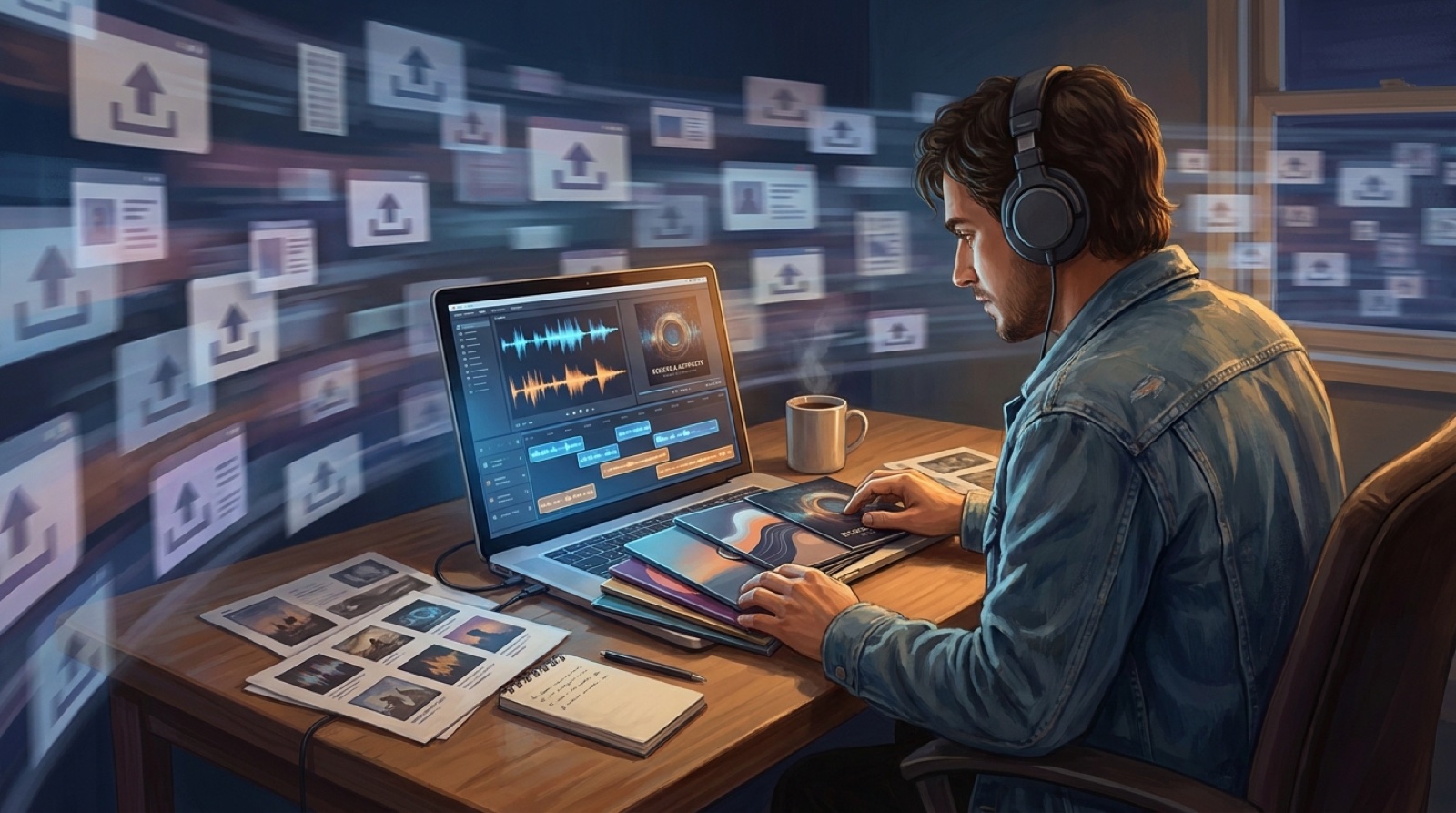
The AI music upload flood is not a reason to panic. It is a reason to stop treating the upload as the whole release. When more generated songs arrive every day, listeners and platforms get faster at ignoring anything unfinished.
A good song can still disappear if the package around it feels random. Static cover art, vague metadata, no video plan, and no proof of human direction send the same signal: this was pushed out because it could be pushed out.
The creator still controls more than it seems. You can make the release easier to trust, easier to watch, and easier to remember before the first listener presses play.
More music makes weak packaging easier to skip
AI tools lowered the cost of making songs. That is useful for artists who had ideas stuck in their heads for years. It also means every feed, distributor, and video platform has more music to sort through.
Le Monde reported that Deezer saw AI-generated tracks become a large share of daily uploads, which shows how quickly the volume problem moved from theory to normal platform work. The exact numbers will keep changing. The direction is clear enough for creators: average presentation gets punished faster when there is more average music around it.
The basic package has to look intentional.
Release quality is bigger than audio quality
Audio quality still matters, but most listeners see the release before they hear enough of the song to judge it.
They see the thumbnail, title, artist page, cover art, first frame, and description. On YouTube, they also decide whether the video gives them enough to watch. A still image can work for known artists, but a new AI music project usually needs stronger visual proof.
Release quality means the pieces agree with each other:
- the cover art feels like the song
- the music video carries the same mood
- the thumbnail makes a clear promise
- the title and description tell people what they are clicking
- the credits and disclosure notes feel calm and plain
None of this has to be fancy. It has to feel chosen.
Give the song one visual anchor
The fastest way to make an AI music release look disposable is to use a different visual idea in every asset. One cyberpunk city for the cover. A fantasy forest for the video. A random face for the thumbnail. A lyric clip with a different color mood.
Pick one anchor before you create the assets. It can be a place, color rule, object, character, album cover, or first frame. Then let that anchor guide the video, thumbnail, shorts, and release page.
For a sad piano track, the anchor might be a rain-streaked apartment window. For a synth-pop song, it might be a neon rehearsal room with one repeated jacket color.
Make the video prove effort in the first seconds
The first seconds of a music video do not need to explain the whole story. They need to prove that someone directed it.
Start with a frame that matches the song mood. Show motion early. Change the scene when the song changes. Keep the chorus stronger than the verse.
This is where a full video helps. A finished song can carry a simple arc: setup, lift, peak, and afterglow. Viewers feel when the video moves with the record instead of sitting beside it.
If you only have time for one visual upgrade, improve the first frame and chorus moment. Those moments often carry the thumbnail, short clip, and early trust.
Clean metadata makes the release feel less rushed
A lot of AI music looks weak before anyone hears it because the metadata feels rushed.
Use a clear song title. Keep the artist name consistent. Write a description that says what the song is, what world it belongs to, and where people can find the full release.
Avoid stuffing the description with tool names. Use tool details only where they help listeners understand the release or where platform rules require disclosure.
Keep proof files before you need them
The more AI music gets uploaded, the more trust questions creators will face.
Keep a small proof folder for each release:
- final audio export
- cover image or visual anchor
- lyric or prompt notes
- final video file
- thumbnail source file
- short clips
- credits and disclosure note
- upload date and live links
This makes the release easier to update, defend, remix, pitch, or package again later.
Build the release package before upload day
The worst time to solve packaging is five minutes before publishing. By then, the files are scattered and the creator is tired.
Build the package while the song still feels fresh:
- one full music video
- one thumbnail
- one vertical chorus clip
- one cover image
- one short description
- one credit or disclosure note
- one archive folder
That is enough for many independent AI music releases. The song should not enter the upload flood with only a static image and a weak title.
Use SceneLore when the song already has a direction
SceneLore works best when you have a finished track, a cover image, or a clear visual anchor. You do not need to prompt every scene by hand or stitch short clips together. The stronger the anchor, the easier it is to turn the song into a full video that feels connected.
If the AI music upload flood makes anything clear, it is this: finished songs need finished packaging. The artists who look more careful will be easier to trust, even when the tools behind the music keep changing.
FAQ
What is the AI music upload flood?
The AI music upload flood is the rapid rise in generated songs being uploaded to streaming and video platforms. For creators, the practical issue is that weak or unfinished-looking releases become easier to ignore.
How can AI musicians stand out without a big budget?
Use one clear visual anchor, make a full video or strong first-frame clip, keep metadata clean, save proof files, and make the thumbnail match the song mood. The goal is a release that feels chosen, not expensive.
Does every AI song need a full music video?
No. A full video is worth it when the song is a single, channel proof piece, playlist pitch, or core release. Smaller tracks can use a Canvas loop or short clip, but the assets should still feel connected.
Related guides
Turn one finished song into a stronger release
Use SceneLore to turn a track, cover image, or visual anchor into a full music video and launch assets that feel connected.
Create Your First Video